
Negotiation Workshops: What To Expect From Aligned

Negotiation is one of the few business skills that touches everything:
It shows up in procurement and sales.
It shows up in internal alignment meetings.
It shows up in partnerships, legal reviews, and resource decisions.
And yet most organizations still train negotiation like it is a one-off event. A slide deck. A few tips. Then everyone goes back to real life.
A negotiation workshop is different. It is the most practical way to build negotiation capability because it combines shared language, real practice, and feedback in the same room.
In this guide, we'll cover:
What a negotiation workshop is (and what it is not)
Why workshops outperform typical training formats
How Aligned’s negotiation workshops are designed
What to expect when your team attends an Aligned negotiation workshop
What is a negotiation workshop?
A negotiation workshop is a structured, hands-on training experience where participants learn a set of negotiation concepts and then practice them immediately through realistic exercises.
A strong workshop typically includes:
A shared framework to diagnose negotiations and choose the right approach
Live simulations that feel like real business situations
Debriefs and feedback that turn experience into repeatable skill
Tools and templates that help participants prepare and execute after the workshop ends
Unlike a lecture, a workshop is designed for behavior change. It is where people test how they show up under pressure, not just what they know in theory.
Why negotiation workshops are the best format for training (especially for teams)
Most negotiation failures are not knowledge failures. They are execution failures.
People can recite best practices and still:
Avoid conflict and concede too quickly
Jump to proposals before they understand the other side
Negotiate as individuals, even when the deal requires a coordinated team
Over-index on being “nice” or “tough,” depending on personality and stress
Workshops help because they create conditions that mirror the real work.
1) Workshops build a common language
Negotiation gets messy when every function uses different mental models. Workshops give teams shared terminology and a consistent way to plan, communicate, and align.
2) Workshops turn insight into muscle memory
Negotiation is a performance skill. That means practice matters. Real-world simulations create “safe pressure” so participants can try approaches, see consequences, and adjust.
3) Workshops surface team dynamics, not just individual skill gaps
In real negotiations, the internal side often determines the outcome. Misalignment, unclear authority, and conflicting incentives leak into the negotiation and weaken leverage. A workshop lets teams see that dynamic in real time.
4) Workshops create faster adoption
Because participants practice with tools and structured process during the workshop, it is easier to apply them immediately afterward. It's not just theoretical.
The Aligned approach: training built for how negotiation actually works today
Aligned workshops are designed around a simple belief: Modern negotiation is not about “winning.” It is about balancing outcomes, relationships, and execution. It's about creating alignment.
At the core is the Aligned Strategic Framework (ASF), which organizes negotiation into three pillars:
Relationships: trust, rapport, communication, and the human dynamics that shape outcomes
Goals: the outcomes you are pursuing, the value at stake, and the terms that matter
Process: the structure, phases, and coordination that keep a negotiation on track
This matters because most negotiators naturally over-index on one pillar.
When the pillars get out of balance:
a Goals-heavy approach can damage trust and long-term partnership
a Relationships-heavy approach can lead to value leakage and conflict avoidance
a Process-heavy approach can create analysis paralysis and slow momentum
Aligned workshops teach teams how to diagnose which pillar is missing, and rebalance quickly.
What Aligned teaches inside a negotiation workshop
While the agenda can vary by level and audience, Aligned workshops typically blend:
A modern negotiation methodology
Participants learn how to think about negotiation types, phases, and strategic choices.
The Four Types of Negotiation
Not every negotiation is the same. Aligned teaches four types so participants can choose an approach deliberately:
Bargaining: narrow scope, claim value, usually price or a single term
Trading: multi-issue negotiation using conditional exchange
Creating: expand the pie by uncovering interests and designing options
Partnering: long-horizon value with governance, trust, and shared wins
The Four Phases of Negotiation
Aligned teaches a practical process that teams can use immediately:
Prepare
Communicate
Propose
Align
A consistent theme inside Aligned workshops is that many teams under-invest in the Communicate phase, and Propose too early.
Workshops help participants slow down, ask better questions, and use communication to earn information advantage before they exchange offers.
Live simulations that feel real
Aligned workshops are case-driven. Participants do multiple rounds of simulations across different negotiation types, including:
internal alignment and resource allocation scenarios
multi-term trading scenarios with packages and conditional proposals
bargaining scenarios with power asymmetry and anchoring dynamics
creating scenarios where value depends on creativity and structure
Feedback, reflection, and coaching
Practice alone is not enough. Aligned workshops include structured debriefs so participants can translate experience into repeatable behavior.
Tools, templates, and “next day” application
Workshops are designed to leave participants with practical tools they can use for their next negotiation, not their next training.
What to expect from an Aligned negotiation workshop
If you are sending (or plan to send) your team to an Aligned workshop, here's what the experience typically feels like.
Expect a high-practice format
Most of the learning comes from doing. Participants will prepare, negotiate, receive feedback, and repeat.
Expect productive discomfort (without the performative “role play” vibe)
Negotiation involves conflict. Something many people are avoidant of. Aligned normalizes that. Participants learn to treat conflict as information, and manage it productively.
Expect a strong facilitator presence
Facilitators set the tone early. They read the room, create psychological safety, then stretch participants with realistic pressure and direct feedback.
Expect a focus on both internal and external negotiation
Teams do not lose leverage only at the table. They lose it before the table, when internal stakeholders are misaligned. Aligned workshops train both.
Expect language that sticks
Aligned teaches frameworks and vocabulary that teams can reuse:
ASF, negotiation types, phases, and structured preparation. This becomes the basis of a shared negotiation culture.
What’s inside Aligned’s workshops (and how they are structured)
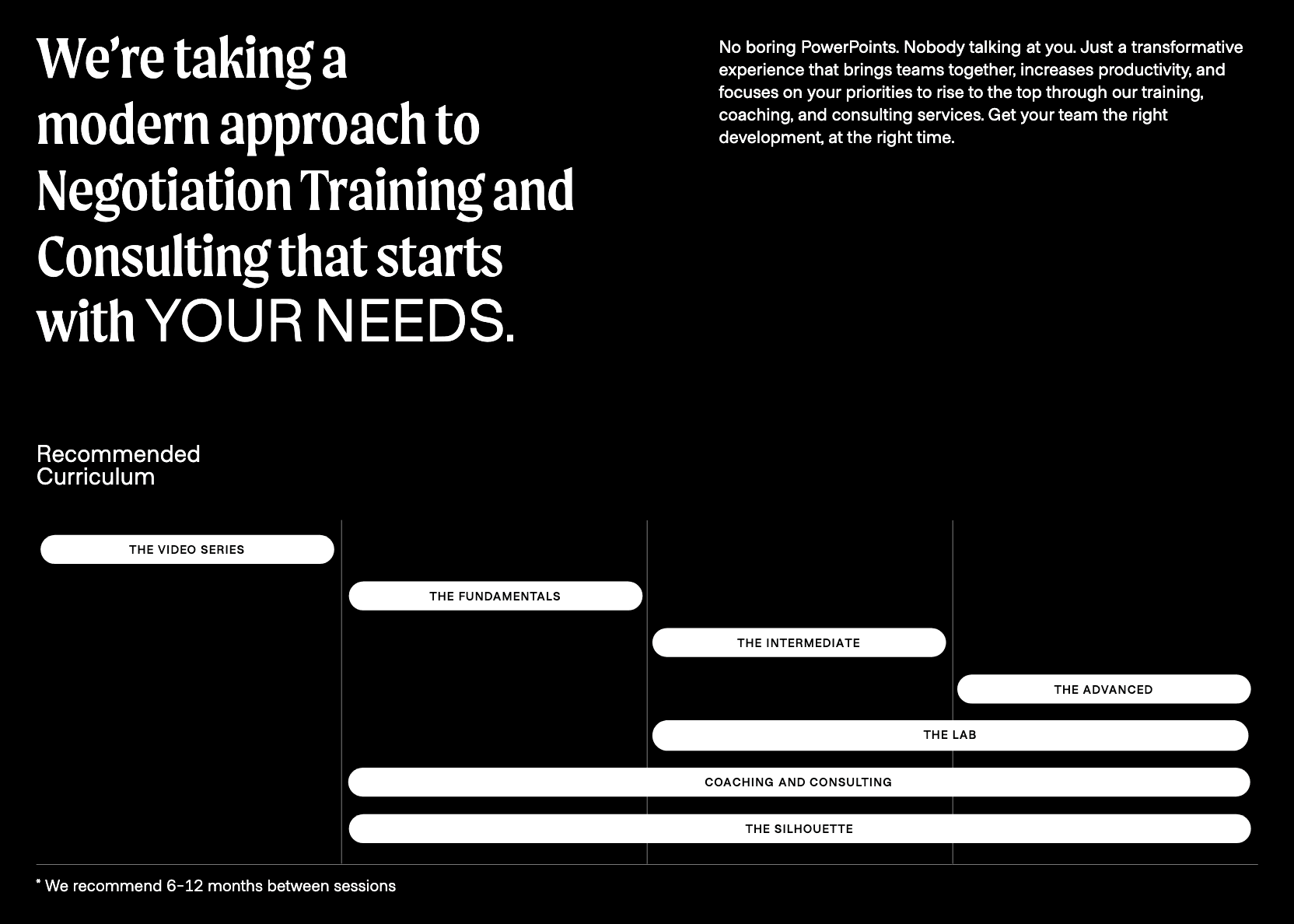
Aligned offers negotiation workshops for all levels:
Fundamentals
Intermediate
Advanced
The Lab
Who negotiation workshops are best for
Negotiation workshops are most effective when:
The organization is ready to build a common language and shared standards
Participants have real negotiations coming up and want immediate application
There is cross-functional complexity (procurement, legal, sales, finance, operations)
Leadership wants capability that compounds over time, not a one-time event
Final takeaway
If negotiation outcomes matter to your business, negotiation training needs to be more than information. It needs to be practice.
A well-designed negotiation workshop gives teams a framework, shared language, and repeated reps under realistic pressure. Aligned workshops are built to make negotiation understood and approachable, while still being rigorous about results.
Get in touch with the team today.